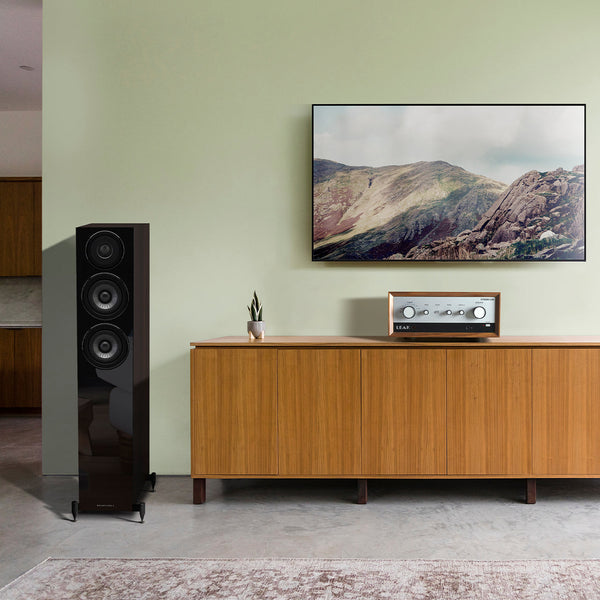
The best speakers for your room aren't the biggest or most expensive — they're the ones matched to your space, your amplifier, and how you listen. Get those three things right and a modest pair will outperform an ill-matched premium set. Here's how to choose, step by step.
Start with your room size
Room size is the single biggest factor:
- Small to medium rooms (roughly 10–25 m²) — bedrooms, studies, apartment lounges — suit bookshelf (stand-mount) speakers. On proper stands they image beautifully without overloading the room with bass.
- Larger or open-plan rooms (around 18 m² and up) — suit floorstanding speakers, which move more air and deliver fuller bass and higher volume without strain.
Not sure which way to go? Our bookshelf vs floorstanding guide breaks the decision down in detail.
Get the placement right
Placement can make a budget speaker sing or a flagship sound flat:
- Give them room to breathe. Keep speakers 30–50 cm from the rear wall to reduce boom; pull them further out for a more open, three-dimensional sound.
- Ear height matters. Bookshelf speakers belong on dedicated stands (around 60–70 cm) so the tweeter sits near ear height.
- Toe-in. Angle the speakers slightly toward your seat for a focused image; reduce the angle for a wider, more relaxed soundstage.
- Symmetry. Keep both speakers a similar distance from side walls so the left/right balance stays even.
Match the amplifier — not just the wattage
A speaker is only as good as the amplifier driving it. Two numbers matter more than headline power:
- Sensitivity (in dB) — higher means louder for the same power, so the speaker is easier to drive.
- Impedance (in ohms) — an 8Ω speaker is an easy load for almost any amplifier; a 4Ω speaker asks a little more and rewards a more capable amp.
Aim for clean, stable power in the speaker's recommended range rather than chasing the biggest wattage figure. Each product page lists sensitivity, impedance and recommended power.
Do you need a subwoofer?
For everyday music in a small-to-medium room, most quality bookshelf and floorstanding speakers don't need one. Add a subwoofer if you're building a home-cinema system, you have a large room, or you simply want more low-end impact.
Quick room-acoustics wins
- Soft furnishings — rugs, curtains, sofas — tame harsh reflections and tighten the sound.
- Avoid corners unless you want maximum (and often boomy) bass.
- A symmetrical layout around the listening seat almost always sounds better than an off-centre one.
Frequently asked questions
Are bookshelf or floorstanding speakers better?
Neither is universally better — it depends on your room. Bookshelf speakers win in smaller spaces; floorstanders win in larger rooms where you want more scale and bass. See our full comparison.
How far apart should my speakers be?
As a starting point, space them roughly the same distance apart as they are from your listening seat, forming a rough equilateral triangle. Adjust to taste.
Do expensive speakers always sound better?
No. A well-matched, well-placed affordable speaker will beat a poorly-matched expensive one. Get the right speaker for your room first, then focus on placement and a capable amplifier.
Still deciding? Read our Wharfedale buying guide or contact us — we'll match a system to your space and budget.